Wednesday, October 10, 2007

Picking a DrySuit

DUI TLSse
-nylon trilaminate material
-rear entry

Why buy a drysuit? For me, the answer has been long in coming. I've been diving in my 7 mm wetsuit in Northern California for 3 years and have stubbornly resisted getting one. First of all, drysuits are prohibitively expensive, running from $1500-2500. They are also baggy and create a lot of drag in the water. Feeling at one with the water is very important to me, and being encased in a drysuit would only separate me further from the water.

Why have I changed my mind? We were starting to do deeper and colder dives. I was tired of ending each dive shivering uncontrollably and near hypothermic. With a drysuit, if I wasn't exactly warm underwater, I at least could quickly warm up on the surface by staying dry. Also, pulling on or pulling off a tight wetsuit especially a 7 mm one is not a fun experience. A drysuit, would be far less strain to don, then a wetsuit. Finally, a nice drysuit seems to be something every long-term self-respecting diver should own.

After almost a year of on-and-off research, I've narrowed down my top choices:
-DUI (Diving Unlimited International), TLSse (see picture above)
-DUI CLXse
-Diving Concepts Pinnacle
-Pinnacle Evolution

DUI CLXse
-Cordura Blend exterior
-Rear entry

DUI TLSse

Walk up and down the Breakwater, and you will see the DUI TLSse (or TLS350) on almost every diver walking by. It costs about $1498 for the fully customized version, as advertised on the DUI website. In summary, this is a drysuit composed of a nylon-rubber-nylon trilaminate material. Trilaminate material, is just a three layer material that was invented for the military in defense against chemical and germ warfare. Usually rubber is the middle layer, providing a waterproof barrier. Because trilaminate material doesn't stretch, these types of drysuits tend to be baggy. The TLSse is less baggy than other trilaminate drysuits offered by DUI because it is a rear-entry (back zipper) drysuit, rather than self-donning (diagonal front zipper). The reason for why rear-entry drysuits are less baggy escapes me.

DUI CLXse

The DUI CLXse is the more hardy version of the TLSse. Like the TLSse, it is a trilaminate drysuit, except instead of having a nylon exterior, it uses a Cordura blend. It is slightly more expensive, running at $1798. (See below.) The Cordura blend makes this drysuit much more abrasion resistant than the TLSse, which is important if you're diving in rougher conditions, or just plain careless with their gear, as I am.

Diving Concepts Pinnacle

The Diving Concepts Pinnacle has cornered the market with the most experienced divers in the Monterey, CA. Instead of trilaminate material, it is composed of a single layer of compressed neoprene. This drysuit is perhaps the most durable of the bunch, and also the most streamlined. Being slightly stretchy, you can get away with using less fabric on this type of suit. The Diving Concepts stock sizes are cheaper than the cost of DUI stock suits. However, the customized Diving Concepts suits are much more expensive than the DUI customized suits, running at around $2000+.

Diving Concepts Pinnacle

Pinnacle Evolution

The Pinnacle Evolution was a front-runner because one of my local dive shops, Blue Water Aquatics, had a good offer on the Pinnacle Evolution. This drysuit also uses the durable Cordura blend trilaminate material. For $1800, the local dive shop was offering the suit at an attractive price, and was giving me the opportunity of patronizing a neighborhood small business that I wanted to support.


Pinnacle Evolution
-Cordura blend exterior
Final Choice - DUI CLXse
My final choice is the DUI CLXse, and it was based on the convergence of price, streamlinedness, durability, customizability, and warranty agreement.
People on Scubaboard rave about the prices for DUI suits offered by Divetank. I called, and found out that they were offering the CLXse, fully customized for fit and color, for $1400. This price also includes the undergarment, a drysuit hood, boots, and gloves. This price was truly unbeatable, by local dive shops and other internet sites.
Streamlinedness was also important to me. The drysuit had to be as conforming as possible in order for me to move easily through the water. Short of the Diving Concepts suit, this suit was as streamlined as any.
Knowing how much abuse I would inflict upon my gear, the durability of the drysuit was paramount. The CLXse was many times more abrasion resistant than the TLSse I was considering. Cordura blend is used on high end sporting equipment and I know first hand how durable this material can be.
Most important was the customization of the drysuit. All customized DUI drysuits are designed around 20 or so body measurements. Neither the Pinnacle, nor the Diving Concepts drysuits have near the sophistication around fit as DUI. Having looked at DUI, Diving Concepts, and Pinnacle's stock size measurements, I realized I would never fit into a stock size. Being Asian, I have wider calves, and shorter legs than most American women. Customization was my only option. At $1400, Divetank was offering an unbeatable deal around the fully customized CLXse suit.
There were various other factors that contributed to my final decision. The sales service around the Diving Concepts drysuits was non-existent. After several e-mails and phone calls, I was told to look up a local dive shop. In contrast, DUI is very well established with accommodating customer service. DUI's 7 year warranty far outlasted any other warranty offered by any other company. Also DUI, I was told, manufactures their drysuits with more care than other brands. The gluing on the interior of their trilaminate drysuits is hand done. The Pinnacle Evolution, by contrast uses machine gluing.

Saturday, October 06, 2007

Annual "Diving Singles" Point Lobos Club Dive

Sunbeams shining through the kelp forest

On August 11th, Chuck Tribolet had his annual Diving Singles club dive at Point Lobos State Park. Chuck Tribolet is the "Diving Singles" club leader, the Bay Area Diving Yahoo Group moderator, and is well known in the Bay Area for his erudite Northern California scuba diving weather web site: Monterey Bay Sea Conditions at a Glance.

Today's dive was a treat. The Point Lobos State Park is well known as one of the best dives in Northern California. Only 15 dive teams are allowed per day and the park is protected from fishing, or scavenging of any sort. As a result, fish are plentiful and unafraid, and the colors here are vibrant.

Everyone gawked as our Mini Cooper convertible rolled into the Point Lobos parking lot. Almost every other vehicle besides ours was a "dive mobile" -- a truck or an SUV built to contain the plethora of equipment typical of temperate water diving. Our convertible top folded away to reveal both my and my fiance's dive equipment tightly packed into our backseat like a Tetris game.

While setting up for the dives, conversation touched upon the death of local diver and photographer, Kawika Chetron. We discussed how he was diving somewhere on the North Coast, and disappeared retrieving his anchor. The most likely hypotheses are either that he got swept to sea, or gotten eaten by a Great White Shark. There are normally several scuba related deaths in Northern California every year. But in Kawika's case, there was extra attention because: Kawika was young, extremely bright (Harvard and Stanford educated), and a talented photographer. See here for Kawika's favorite photos, which combined with his explanatory captions, are great meditations on diving in Northern California.

We did the first dive with two divers unfamiliar with Point Lobos. They seemed anxious to pair up with people who had dove Point Lobos before, so we agreed we would show them around. This dive was fraught with problems,which began as soon as we were dropped off at the mouth of Whaler's Cove. First off, Dive buddy #4 (I forget his name) had problems clearing his ears, so he cut his dive short and swam to shore. Dive Buddy #3 had a continual free-flowing regulator problem, and hence had a low air supply, which cut our dive short. Dive buddy #2, my fiance, had constant mask leaking issues, caused by his mask being set overly tight. He had to surface to calm his nerves and told me he nearly wanted to quit the dive. When we finally got our dive started, I made a bee-line to shore, with little time to enjoy the 50 foot visibility. I was nervous to get back to shore safely.

Below, Mina posing with a Ling Cod

Our second dive was much more enjoyable. We paired up with Dan, a diver we met on Dave M.'s boat. All photographs in this blog entry were taken by him. Starting at the mouth of Whaler's Cove, we did a slow and leisurely crawl back to the boat ramp. We saw a cormorant underwater (my second time). I also encountered some unusual cabezon behavior: I turned over an abalone shell to investigate, and a cabezon shot out from under a ledge to look at the shell as well. I never knew cabezons were so curious, given their usual behavior of perching on a rock. Below is a photograph of a cabezon taken on the dive.

Cabezon

Friday, October 05, 2007

Big Sur, and Interior Design

My diving friends must be wondering right now: "Why would you drive all the way down to Big Sur and NOT dive?" My reasons are the following: (1) To see the iconic McWay falls which I had never seen before (see below), (2) to hang out with friends, (3) and I don't have a drysuit. Either my wetsuit is starting to lose it's insulation, or I'm diving sites that are deeper and more exposed than before, but I am clearly getting tired of being cold.

It's time to get a drysuit, but right now, I am forcing myself into funnelling money into the house (see rest of blog).

Interior Decorating

On Sunday, we met our interior decorator for the first time. How did it come to be that we have an interior decorator? It happened within the last week or two -- a lot faster than you would expect:

I complained to one of my coworkers over lunch that my fiance and I can't agree on what colors to paint our interior walls. We want something non-traditional and vibrant, something that will match our red, Swedish fireplace, and modern, minimalist furnishing. My coworker mentioned that his girlfriend had just started an interior decorating business, that she was a color expert, and that she would give us discounted rates for an opportunity to use our home as part of her portfolio. Well, it has been 2-3 weeks of color gridlock (my fiance can't agree with my choices, and I don't trust myself), so we decided it was time to make a decision, and if it involved bringing a third party, then so be it.

Above, example of decor that we like

Calie impressed me from the get go. She felt no compunction with disagreeing with our ideas ("That's too traditional"). And she immediately had ideas we never had. For example, she thought that we should head away from mixing too many colors in the living room/dining room area because it would make our place seem smaller. Also, she thought we needed an extra floor lamp, and a seating area to utilize the empty corner in our living room.

She also impressed me as someone who has discerning taste, with a clear opinion on who makes the best color paints (Benjamin Moore). Now, I love color, but I don't think I can tell whether Benjamin Moore paints are superior over the ones on display at Home Depot. But plenty of interior design magazines extolled the Benjamin Moore color line, so maybe there is some truth to this...

Here is Calie Anderson's interior decorating web site: http://www.noheainteriors.com/

And here is a link to her blog, where she mentioned meeting us. Some interesting colors, and cool ideas for our house are in germination: http://nohealookbook.blogspot.com/

By the end of our initial meeting, we had gone over magazine clippings that we bookmarked, and agreed to set another date to go over her color proposals.

Thursday, September 27, 2007

A Tale of Two Kelp Forests

The title above is the name of a science lecture I attended yesterday at the U. S. Geological Society. The lecture was being delivered as part of "Sea Otter Awareness Week". It addressed the difference in health between two sea otter populations, one in the Aleutian Islands in Alaska, the other in the adjacent Commander Islands off of Russia. The population in the Aleutian Islands is in serious decline (down 90% over the past 15 years), whereas the sea otter population in the Commander Islands is at steady state, at presumably the ecosystem's carrying capacity.

The lecturer described:
(a) How the marine ecology in those respective islands differed as a result of the numbers of sea otters.
(b) How the population density of otters affected the sea otters' behavior, diet and health

The lecturer also sought to explain why the sea otter population was in decline in the Aleutians, while the the population in the Commander Islands was not. Also, a few fascinating slides were spent detailing the difficulties of studying sea otters in these remote environments.


Impact to Marine Ecology
A solid case was made, in the form of box plots, bar graphs, and photographs that sea otters have a huge impact on the surrounding marine ecology. In very simplistic terms:

*An abundance of sea otters keep the sea urchin population in check, which keeps the kelp forest from being killed off.
*An absence of sea otters allows the sea urchin population to explode, which destroys the kelp forest.

Sea Urchins eating and killing Giant Kelp

The presence or absence of the kelp forest also has manifold effects:
*The kelp forest provides a nursery for healthy fish populations.
*A kelp forest also introduces increased nutrients in the water, which encourages the growth of filter feeders (mussels, clams etc...)

In summary, sea otters are what are called "keystone" predators. Their presence or absence has a large influence on the ecosystem. A subtle point, which I'm sure I don't fully understand, was the non-linear relationship between the number of sea urchins and the biomass of the kelp forest. As the number of sea urchins increases, their destructive effect upon the kelp forest accelerates.

My only challenge to the scientist's assertions are:
(1) Why are Monterey/Channel Island kelp forests relatively less impacted by the lack of sea otters? There are far fewer sea otters off California (2-3,000) vs. off Alaska, Canada, and Washington (~70,000), yet the kelp forests in California continue to exist.
(2) If there are other predators in California that keep the sea urchin population in check, why don't those predators exist off Alaska (wolf eels, for one)?

Impact to Sea Otter Diet/Health
Fascinatingly enough, the sea otters in the Aleutian Islands have grown in size in response to their population decine. The sea otters in the Aleutians (low populations) are the fattest, healthiest sea otters the scientists have ever seen. The scientist called them, "rotund", "jumbo" and happy. With so little competition, these few sea otters have plenty of sea urchins to eat. In comparison, the sea otters in the Commander Islands were smaller, equivalent to the size their Aleutian neighbors were before their population declined. Furthermore, the Aleutian sea otters also have a far less varied diet than their Commander Islands neighbors.

Funny Science Anecdotes
The lecturer got a few laughs describing the difficulties of studying sea otters, from their capture, to surgically implanting radio transmitters into their bodies. Here are some observations:
-Sea otters have a nasty bite
-Catching sea otters in a net is a nightmare, particularly when you are catching a dozen per hour, as was the case when they stretched a net across the sheltered lagoon.
-Rebreathers are required to encounter awake sea otters underwater, because they can smell your bubbles hundreds of feet away.
-A lot of hiking is required in the Russian islands, where there are no trails.
-Mina's aside: science is truly hard work, and often enormous amounts of effort is required to prove every logical step of one's scientific assertions (that's what doctoral students, and master's students are for).

Commander (Komandorski) Islands on the Left, Aleutian Islands in the Center and Right

Probable Cause for Sea Otter Decline in Aleutians
The answer might surprise you: the scientist from UC Santa Cruz hypothesized that the decline in sea otters in the Aleutian islands is attributed to increased attacks from orcas. The main evidence for his hypothesis are as follows:

(1) An increase in orca attacks witnessed over the past 15 years.
(2) An absence of sea otter carcasses found, or sick otters found.
(3) The sea otter population protected by a lagoon that was inaccessible to orcas declined much less rapidly than everywhere else in the Aleutians.
(4) A computer model accounting for the metabolic requirements of both orcas and sea otters predicted that it was a possible for a small group of 6-10 orcas to decimate the sea otter population over the years.
(5) Sea otters in the Aleutian islands stay closer to shore than they used to 15 years ago, and also stay closer to shore than the the sea otters of the Commander Islands.

One of the grey-haired scientists in the audience challenged this hypothesis and wondered if the population decline could not be attributed to pollution instead. The speaker did not have an excellent response to this challenge. He stated that the pollution was the same between Russia and Alaska, but he did not provide any numbers to back up his assertion.

Another scientist wondered why the orcas didn't attack the sea otters off of Russia. Apparently, different orca pods have very different geographical domains. Also, differing orca pods are extremely variant in their diets, behaviors, and even genetics. The "transient" (read: mammal-eating) orcas that supposedly ate the sea otters don't wander into the Russian islands. Supposedly, these orcas developed their sea-otter eating behavior due to the dwindling in their other food sources (harbor seals, sea-lions). The most fascinating thing I heard was that "resident" (read: fish-eating) orcas are as much as 1000 years genetically different from the "transient" orcas.

I went up to the mike and had to ask my bone-headed question. I was probably the only non-scientist in the 80-100 strong audience, and was perhaps the only person below the age of 50, but I braved it out with my unscientific question. I asked if: (1) the rumor that the California sea otter population decline was caused by "feline leukemia virus" was true, and (2) what could have been the cause of death for the 4 foot long dead sea otter I encountered off of Monastery Beach.

The scientist was quite nice in his response. First of all, it wasn't "feline leukemia virus" but another feline borne disease, Toxoplasmosis that was attributed to 17% of sea otter deaths a decade ago. He asserted that sea otters most likely caught toxoplasmosis through the prey that they ate, rather than kitty litter. Toxiplasmosis as a cause of death is in decline, however. He wouldn't elaborate on what caused the myriad of other causes of death in the pie-chart.

He couldn't elaborate on what caused the sea otter that I encountered to die. But he did mention that more than anywhere else, more sea otter carcasses were found in California than anywhere else. Also, a necropsy had to be performed on a fresh sea otter carcass in order to find the cause of death.

I left the lecture feeling good that there was so much science left to be done. There is still much to understand about why sea otters in California are not reaching carrying capacity. There is also so much yet unknown about orcas, and their behaviors.

Saturday, September 22, 2007

Alaskan Cruise, Aug-Sept 2007

Here's a trip report from my recent Alaskan cruise with my mother earlier this month. This was my first cruise, and also my first trip to Alaska. I definitely see myself coming back to Alaska, someday. Alaska's Inside Passage, is a mystical, spiritual, beautiful place. Cruising itself, was also a surprisingly pleasant, eye-opening experience. I probably won't be taking a cruise anytime soon, due to there being too many limitations inherent with cruising. This I will describe in more detail later on in this report.

For those of you who have never been on a cruise, here's a little about cruise ship life. I shared a suite with my mom. The cabin was nicely appointed, with a shower, head, seating area, and even our very own porthole looking out to sea (see left).

We were on a Celebrity cruise line, which, is a top-of-the-line (read expensive) cruise line. The clientele were mostly my mother's age. There were very few people my age in attendance, other than those accompanying their parents. This was a veritable floating hotel with glass elevators (see right), and private nooks from which to view glaciers (see right).

Below, leaving the protected bay of beautiful Vancouver for Alaska's Inside Passage The most mind-blowing thing about this cruise vacation was seeing wild-life surrounding you while carrying on with everyday activities aboard the ship:

For example:
  • While contemplating the ocean view while in the sauna in our bathing suits, I spot the a group of humpback whales. This was a particularly zen-like experience.

Below, a view of Hubbard glacier from the cafeteria hall

This wouldn't be my only surprise encounter with wildlife from aboard the ship. Other moments:

  • Running on the treadmill: watching as the cruise ship approached, and ultimately overran a sprinting pod of 30+ strong porpoises. I remember hoping that no porpoises were hurt.
  • Jogging on the deck: stopping in awe at humpback whales.
  • Eating lunch: running out to gawk at orcas alongside the ship. The image of the male orca's 6' high dorsal fin making its cyclic, mechanical slice through the calm waters has forever been burned into my memory.

Below, enjoying the sun in the Inside Passage

The other nutty thing about cruise life, is the incongruity of having all of this entertainment packed into a boat. It was like Disneyland, but afloat. There was a full scale two story amphitheater, inside of which one would have never suspected one was on a boat. There was an art gallery from which daily live auctions were held. A smoke filled casino straight out of Vegas, a state of the art gym, a saltwater whirlpool the size of a pool. Shops selling expensive diamond encrusted watches. Countless bars, restaurants, night clubs and even an Italian cafe to drink espressos.

Above, drinking a martini flight with Andrea (a friend I made on board the cruise)

If you enjoy gluttony, than cruise life is for you. There was a never-ending parade of food. My favorite meal of the day was breakfast, where I and my mom could eat al fresco on the stern of the ship.

Above, breakfast with my mom

Breakfast consisted of the usual eggs and bacon, but there were also nods towards Alaskan cuisine, such as smoked salmon, smoked trout and pickled herring. Catering to the Asian clientele was a Chinese rice porridge station and Japanese miso soup station.

Above, dinner

Dinner was my least favorite meal of the day, due to there being a strict dress code (formal wear-2 nights, semi-formal wear-1 night, jeans were never allowed). Also, by the middle of the week, I was becoming slightly stressed by always being seated with my mom's high-school classmates.

This Alaskan cruise also happened to be my mom's 40th high-school reunion. There were about 40 other former classmates and their families on board. At any rate, as on any extended boat trip, one eventually wants to get away from people, no matter how nice the company.

The shot I took of the top deck, above, looks straight out of a travel brochure

Earlier, I mentioned there were certain limitations to cruising. The biggest limitation is never being able to truly experience a place deeply. I always felt as though I was viewing Alaska behind a thick pane of glass. We stopped at 4 stops during the week long cruise. At each spot, one was limited to a few daylight hours to explore the spot. This prevented one from exploring beyond the touristy areas designed to ensnare cruisegoers.

Above, salmon spawning in a stream

The first stop after a day at sea was Ketchikan, Alaska. On this particular stop, I chose to do a snorkeling excursion. The dive operation was Mountain Point Snorkeling. The water was warmer and clearer than in California. But the water that day was also more barren.

Below, a picture taken by Belinda Li of entering the water

We saw unfamiliar starfish, including the sunflower star, that is supposed to be the same as the ones in Monterey, but which seemed more fragile than the indestructible ones I've encountered in Monterey. I freedove to a depth of about 20 feet to watch a couple of wolf-eel for the first time. One wolf-eel was slithering out in the open and chomping away with its powerful jaws on a poor crab. To my surprise, the wolf eel had stripes. As I faced it on the bottom, it stopped chomping and stared back at me stupidly with its beady eyes. (Sorry, no photos, don't have an underwater camera yet).

Below, a picture taken by Belinda Li of myself free-diving

Below, a close up view of Mendenhall Glacier

I asked about scuba diving in Ketchikan. They don't take too many people scuba diving in Ketchikan due to the strong current in the passage. The tide comes twice daily in Alaska, and is famously strong, sweeping water up and down as much as 20 feet. The current I experienced that day was wickedly strong.


Another fun excursion was viewing the Mendenhall glacier (see above, and below). I took a detour from the main path to get as close to the glacier as I could. There were only a few people who got to witness the glacier from such close proximity. I nearly missed the bus on my way back, however, since I got detoured, and had to climb several steep rocks to get back on path.


At right and below, Mendenhall glacier up close


Beyond a shadow of a doubt, my mother's favorite excursion was salmon fishing off of Icy Strait Point. She was pretty excited about catching her Coho salmon (below). I caught two Coho salmon. The Coho salmon are famously tough. My first salmon had been bludgeoned in the head, but still beat furiously in the icebox for a good 15 minutes before expiring for good. I had to go inside the boat to escape the horror.


Below, Alaskans dressed in Tlingit costume at Icy Strait Point.Juneau was my favorite stop. Juneau is a charming town that is accessible only by plane or boat, and is surrounded by an ice field and glaciers. It has the same bohemian, laid back spirit as Seattle (see below). There was one good coffee shop in which I enjoyed a very good caffe latte. I thoroughly enjoyed shopping for native American Tlingit inspired art. See here for an example. I bought two prints of orcas (my self-proclaimed totem animal), and one print of a harbor seal, which I intend to hang up on my walls.


From Juneau, we also went on a whale watching and wildlife excursion, which I highly recommend, despite the price of $100/person. We ended up seeing porpoises, Stellar sea lions, humpbacks, and bald eagles. I was fascinated by seeing the Stellar sea lions, who are much larger than the sea lions we see here in Northern California, and whose voices, consequently, are much lower. Their calls sound more like growls, rather than barks. I learned from Seneca, the Juneau born naturalist on board, about the various behaviors of the species there, which is probably too boring to include here.


As we headed back to Vancouver, I tried to capture the magical mystical quality of the Inside Passage. Here is a view taken at sunset:

Saturday, September 15, 2007

Wedding Priorities

Today, Mark and I sat at Peet's for some coffee and we generated a spreadsheet to prioritize our expectations for our wedding. A "high" means we think it is important to have high quality for that particular aspect of the wedding. A "low" indicates we have no expectations, and wouldn't be crushed if it didn't even happen. This exercise was inspired by our friend, Coco, who recently got married. Her advice for how to live through wedding planning: have low expectations for everything but the few truly important things. This exercise was to find out what those truly important things are.


Fortunately, we have very similar views. For example, neither of us care about wedding cakes, or wedding photographers. So we probably won't buy or hire either. Neither of us care about having a bachelor/bachelorette party either, so we won't be crushed if these don't happen for us either. Actually, the only thing we both care a lot about was having the wedding at the Descanso Beach Club.

Where there was a difference in priority, the person who cared more was placed in charge for that particular thing. For example, I care more about having an engagement photographer, and wedding invitations than Mark, so I have ended up "owning" these particular items. Mark cares more for food and the wedding registry than I do, so he's been placed in charge of these things. My feeling on the wedding registry is that people can buy us fun scuba diving gear (such as a nice underwater camera setup), but that didn't fly with Mark, who thinks that appears selfish. So I put him in charge of that.

As you can see below, neither of us care about the actual wedding ceremony itself, meaning the sharing of vows etc..., so I'm not sure what we will do there.

Saturday, August 04, 2007

Cozumel Dive Trip, July 2007


Mark and I just returned from a week long dive trip in Cozumel, Mexico. Since we want to save money for a wedding and honeymoon next year (wedding on Catalina Island in California, honeymoon in either the Galapagos Islands, or somewhere in the South Pacific), we wanted to vacation somewhere optimizing value and quality diving, so we opted for Cozumel.

This was our first time back to Cozumel since getting open-water certified on the island 6 years ago. Since getting certified, we'd amassed quite a few dives, gained more dive experience, and can better appreciate the subtleties of marine life better than we first did many years ago.
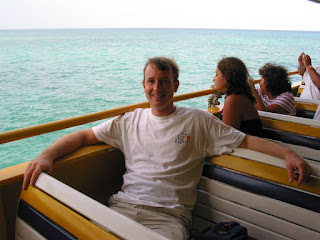


Since coming back, we were also able to dive Cozumel’s advanced dives most notably “Devils’ Throat”. This dive is famous, not only for it's claustrophobic swim-throughs (hence the name), but also because it is planned as a decompression dive. I felt excited and scared before the dive, but the actual dive itself was easy, and thrilling. A more detailed dive log can be found later in this entry.

Cozumel is an island that can be reached by ferry boat (see left) from Playa del Carmen, a town on the Yucatan mainland. Cozumel does get frequented by numerous cruise ships, however, there is not much to do in Cozumel besides diving.

In Cozumel, we stayed at a diver's hotel called Caribe Blu, which costs $70/night. The Caribe Blu was the perfect mixture of comfort and price. Some on Scubaboard (a scubadiving forum) complain that this hotel is too spartan - that there is inadequate hot water, and inadequate air-conditioning. However, I had no such complaints. Had we booked a more expensive hotel, I would have felt cheated, and probably wouldn’t have been able able to enjoy myself.

I enjoyed the décor of the hotel, which was organic, artsy and beach-inspired (see picture of bathroom, right). There was security in the lobby every night, which made me feel safer. Also, the hotel was right on the water. Every hotel
room had a patio overlooking the sea (see below). Many an hour was spent on the patio reading the latest Harry Potter novel.

For our dive operation, we used Blue Angel, which is conveniently located next door from the hotel. Blue Angel was highly recommended by people on Scubaboard. We were quite pleased with Blue Angel, and would use them again in a heartbeat. Every morning, our dive routine was as follows:


  • Wake up at 7:30 AM.

  • Sip coffee at Rendez-Blu, the small café over the dive shop, as we watched the fastboats pull up to the pier in front of the hotel.

  • Board the "fast boat" to the dive sites. The “fast boats” leave at 8:30 AM. The “slow boats” leave at 10:30 AM. Fast boats are for serious scuba divers. Slow boats are for beginning divers, and snorkelers. If you are a serious diver, opt for the fast boat and your dives will get more interesting (more advanced dive sites are further south).
  • All in all, we did 15 dives over 5 days. In Cozumel, considering the depth of most dives, 3 dives/day were plenty. In fact, we almost got the bends by the end of the trip (more on that later).

    Here is a summary of our actual dives. All underwater pictures were taken by Mark Tyler, who was on the same boat dives we were on.

    Dive 1: Santa Rosa Wall

    Max depth: 88'
    Time: 0:56

    Observations: The most nitrogen loading I had yet experienced, but not for the entire trip.

    Considered to be one of Cozumel's best dive sites, but I don't think it was as good as some of the other dives we were to do.

    Dive 2: Paradise Reef

    Max depth: 42'
    Time: 1:15

    Observations: Pumba, the DM, finds us two seahorses (the first time I'd ever seen in the wild), and a fingernail sized, colorful worm eating some algae (don't know the name, but also a first)

    2 moray eels

    To date, this was the longest dive I'd ever done!

    Dive #3: Palancar Gardens

    Max depth: 94'
    Time: 0:56

    Observations: Palancar Reef is one of the most famous dive sites in Cozumel. The saying goes that after Jacques Cousteau dove these reefs, he declared Cozumel to be one of the best dive sites in the world. I can see why he was inspired to say this after diving the "Garden" portion of this immense reef. Palancar Gardens is full of big coral buttressess and swimthroughs, which are typical of the coral formations you find at Cozumel.

    The coral here is some of the healthiest I've ever seen. Hurricane Wilma had devastated much of the coral life in Cozumel. However, the coral has already begun to recover. Everywhere I looked were tiny miniature pinkie-sized purple sea fans and barrel sponges taking over where the old coral had been swept away. Nibbling on these tiny corals, too, were baby stoplight parrotfishes and baby trunkfishes. This was typical of all of the diving in Cozumel.


    Dive #4: La Francesca

    Max depth: 64'
    Time: 1:04

    Observations: We observe a big sea turtle munching on coral. A pair of gray angelfishes bravely pick up the scraps.


    Dive #5: Night dive at Paradise Reef

    Max depth: 45'
    Time: 1:04

    Observations: I manage to stumble upon 2 great finds: I swim directly over a huge deformed lobster with a head the width of my outspread hand. It appeared to have no claws, and not much of a tail. I find out this wasn't some mutant experiment, but a huge Slipper Lobster. I was pretty repulsed by this animal.

    I stumble upon a Splendid toad fish , a species endemic to Cozumel. I and Jose managed to coax out the fish into the open, which is not something that is often seen. Even DM Jose was pleased to see this.

    Dive #6: The Cathedral, Punta Sur


    Max Depth: 109 feet
    Time: 0:47

    Observations: This dive site has majestic walls and buttresses, swimthroughs and channels. The Punta Sur reef is one of the most famous sites in Cozumel for its awe-inspiring vistas, and for its challenging conditions. Black tip reef sharks lingered at 150 feet, just beyond our visibility.

    This was the first time I'd ever entered deco. I followed the DM around the numerous coral towers until my computer finally reached the dreaded deco screen. I'm ashamed to say, I wasn't well prepared, and I didn't know how to interpret my dive computer's instructions. I somehow managed to get out of deco by following the other divers. That night and the following morning, I studied the computer manual to understand how to interpret it's decompression instructions.


    Dive #7: Cedral Wall

    Max Depth: 74 feet
    Time: 1:09 minutes

    Observations: Tiny drum fish flaunting its stuff inside a hole (see above for Mark's picture of this tiny wonder).

    Got stung by stinging hydroid while trying to maintain position in the current looking at a green moray eel.

    A turtle brushes Mark in the head in its eagerness to munch food (see pic of Mark being brushed by the turtle at left).

    Dive #8: Palancar Bricks

    Preceding Surface Interval: 12+ hours
    Max depth: 97 feet
    Time: 0:59 minutes

    Observations: Saw a blue butterfly fish that was probably a juvenile surgeon fish(?)

    Dive #9: Cedral Shallows

    Preceding Surface Interval: 0:54 minutes
    Max depth: 97 feet
    Time: 0:59 minutes

    Observations: Huge green moray (picture of me and the moray left).

    Pumba took us through a labyrinthine swim through.

    Dive #10: Twilight dive at Punta Tunich

    Preceding Surface Interval: 5:34 minutes
    Max depth: 82 feet
    Time: 0:54 minutes

    Observations: There were 10 people diving with us this evening. In the confusion of gearing up on the small boat, I forgot my weight belt. During the dive, as my tank emptied, I had to compensate for my lack of a weight belt by exhaling a lot. Later on in my dive, I had to pick up a heavy conch shell to compensate for the depleted air in my tank. I was frowned upon deeply by DM Jorge for picking up the shell. The DM's in Cozumel are anal retentive about collecting things off their precious reefs. Later, I nearly dropped the shell on Mark's head in my eagerness to return the precious shell to the reef.

    This dive site is known for its ripping, ripping current. A fair kicking pace was only sufficient in keeping a diver in the same place. We pretty much gave up trying to control where we were going. In the midst of all of this current, we manage to stay in place enough to spot a scorpion fish.

    Dive #11: Night Dive at Paradise Reef

    Preceding Surface Interval: 0:43 minutes
    Max depth: 43 feet
    Time: 1:02 minutes

    Observations: This was a crazy night dive with 10 people (some of whom hadn't dove in 7 years). Surprisingly, it was very civilized, with noone colliding into each other. Once again, DM Jorge did an excellent job of shepherding everyone in the right direction.

    The thing I enjoyed the most on this dive was diving alone at a fair distance away (10-15 feet) from everyone else - this gave me a great sense of independence and self-reliance. DM Jorge didn't even dive with a light half the time, but I knew he was there from the flashing beacon he wore, and by the ambient light carried by all of the other divers.

    Mark saw a huge 2.5 foot long puffer fish.

    Dive #12: Tormentos

    Preceding Surface Interval: 12+ hours

    Max depth: 66 feet
    Time: 1:03 minutes

    Observations: Started to notice creatures in the sand flats, such as the yellow head jawfish.

    Dive #13: Chankanaab Bolones

    Preceding Surface Interval: 0:54 minutes
    Max depth: 65 feet
    Time: 0:58 minutes

    Observations: We see our first trumpet fish in Cozumel. In the Bahamas, these were virtually on every dive.

    I saw a pair of longsnout butterfly fishes for the first time - a rare sight.

    Dive #14: Devil's Throat, Punta Sur

    • Preceding Surface Interval: 2:17 minutes
    • Max depth: 129 feet
    • Time: 0:47 minutes

    Observations: We were finally granted our request to dive Devil's Throat after days of requesting and lobbying. However, dive shops won't allow people to dive this site until they've been observed diving for several days.

    This dive site well earns its reputation as being one of the best dive sites in Cozumel. A lot of people say that there is nothing to see, but I disagree. There were three circuitous swim throughs opening out into immense blue vistas plunging into the depths. Colorful coral growth line all the tunnels, and we even saw a huge crab, and a school of glassy sweepers inhabiting one cave. Unlike what some people say, the swim throughs have plenty of light and diving with a light is unnecessary. However, without a light, you'd miss out on the colorful life within the caves. One of the divers lost their fin in one of the tunnels at 100'. This could have been a panic situation, however, we managed to calmly swim out of the tunnel. DM Jorge descended upon the scene like a hawk and assembled the diver's fin strap back together.

    I was feeling adventurous and a bit stupid, so I decided to explore the coral reef, even though I had already entered deco and even though everyone else had started their decompression stops. I had a ton of air, you see, and wanted to push the boundaries of my diving. Mark was furious with me and kept signaling me to surface. I kept waving him away - I had so much air. Finally, I felt a bit uneasy when the rest of the group disappeared from my vision. I had been carried off in the current. I began my decompression sequence with Mark beside me. Unfortunately, I was rewarded for my adventurousness with a 12 minute decompression obligation at 10 feet. Mark was confused as to why I didn't surface sooner and I kept signaling him that my computer wouldn't let me. The divers on board the boat wondered how much air I had left. I still had 1300 psi after the entire dive was over.

    Dive #15: Columbia Shallows

    Preceding Surface Interval: 0:05 minutes
    Max depth: 40 feet
    Time: 1:00

    Observations: I think that it is a well-kept secret that this might be the best dive site in Cozumel. It is far enough from all the major hotels and dive operations to make it less frequented by people and this is perhaps the reason why it has so much fish life. This was by far and away the most life I've ever seen in one dive spot, including Monterey and Carmel, which generally have more life than Caribbean sites:

    • 2 flamingo tongues

    • 4-5 large groupers that would burn trails through schools upon schools of grunts and schoolmasters.

    • Sergeant major and its nest of purple eggs. It successfully wooed a female sergeant major into laying more eggs in its nest while we watched! This reminded me of California Garibaldi behavior.

    • Arrowhead crabs

    • All of the above could have easily made this one of the best dives ever. But what topped it off was the pod of common Bottlenose(?) DOLPHINS that swam upon the scene. Mark had used his noisemaker to alert us to an eagle ray in the distance. The noisemaker must have conjured up the dolphins because they burst upon the scene, chasing the eagle ray away. They lingered for 5 precious seconds before disappearing into the distance. Everyone put their hands to their heads and started screaming with disbelief.

    Epilogue:

    On our last day of diving, we did the most aggressive diving I've ever done. In retrospect, I think we almost got the bends:

    In the morning: we did two “shallow” (if you count 60+ feet/ 1 hour long dives shallow) dives in the morning. After lunch, we followed this up by diving “Devil’s Throat”. Devil’s Throat is an infamous deep dive in Cozumel that is planned as a decompression dive. After about 15 minutes of being led through the swimthroughs, I had plenty of air, so I decided to wander around the deep 80+ foot reefs, although I had already exceeded my no-deco limit. Mark, was quite upset at me. I was also rewarded with a 12-minute decompression stop 10 feet below the boat. After Devil’s Throat, we barely had a breather before doing a 4th dive at Columbia Shallows merely 5 minutes later. Even though the dive was only 40 feet deep, I went into decompression again, and had to perform a 3 minute decompression stop at 10 feet.

    After we left the boat, Mark and I felt the strangest we ever had after diving. We felt completely wiped out, sedated even, and laid on our hotel beds in a daze. I could barely rouse myself from bed to eat dinner. Furthermore, we felt faint tingling in our extremities. I could even feel tingling through my carotid arteries. We didn’t feel uncomfortable, rather, we felt relaxed, like we had just had a nice relaxing massage. I was concerned that we had developed signs of the bends, but when I suggested to Mark that we get ourselves to a hyperbaric chamber, he just laughed it off. Eventually, the symptoms disappeared the following day. Besides, the feeling was nice. We wouldn't fly until 48 hours later.

    I posted this particular day’s dive profile on Scubaboard, a popular dive bulletin board, and got lambasted by several senior members, including Christi, the owner of a successful dive shop on Cozumel Island. She and others said that I and the divemaster had been irresponsible, and that we had better conduct a review of basic diving fundamentals. Here is a link to that thread:

    http://www.scubaboard.com/showthread.php?t=196513

    People were basically attacking us for several reasons:

    (1) They attacked why we did such a short surface interval after Devil’s Throat before doing our 4th dive.

    (2) They criticized us conducting the deepest dive of the day as the third dive. Everyone has been taught to do the deepest dives first, as most of the Navy and Haldanean dive research was conducted performing the deepest dives first.

    (3) Finally, they criticized the fact that I had pushed my first two dives into the yellow, knowing that we would do Devil’s Throat in the afternoon.

    I was pissed off and upset by this electronic onslaught. To this day, I still don't see a problem with performing (1) and (2) above. My rebuttal to point (1) is as follows: Jorge the DM intended the 4th dive as a decompression stop, hence the short surface interval preceding the 4th dive. Also, the diving was aggressive, but we surfaced without violating any computer limits.

    My rebuttal to Point (2) is as follows: Although, it is not a recommended practice, because not much is known about diving deep after diving shallow, the computers were able to handle it. When reviewing Mark's dive log, we found out that he never even entered deco (although my computer gave me a 12 minute decompression penalty).

    The only thing I agree was stupid, was point (3). It was reckless to have conducted two “caution” yellow dives, knowing this would be followed by a red “alarm” deco dive. I should have surfaced early on the first two dives to incur less nitrogen loading before performing the deep third dive.

    I believe I was lulled into complacency with the ease of diving in Cozumel, which explains why I became reckless. In Cozumel, we were never concerned about navigation, because the boat always found our bubbles. Nor were we limited by feeling cold. We got spoiled, and we ended our dives much later than we otherwise would have (1 hour).

    I think it was stupid to be so reckless on this last day of diving. I was intentionally pushing my limits to see what would happen. Perhaps people on Scubaboard, were repulsed by a young woman being reckless. Also, I think Christi was trying to generate negative publicity against a rival shop.

    Compared to other sites in the Caribbean, I would say Cozumel was better in many aspects. The sponge and coral life in Cozumel was far more colorful than in the Bahamas, and especially Florida. The coral buttresses that are characteristic of Cozumel created some of the most awe-inspiring natural scenery I have yet witnessed underwater.

    However, the fish in Cozumel tended to be smaller than in the Bahamas, or Florida (you can’t get much bigger than sharks in the Bahamas, or the Goliath Grouper in Florida). Cozumel had more juvenile fish than large adults. Perhaps Cozumel's absence of big fish is a result of its recovering from the damage done by Hurricane Wilma. Also, there generally were less fish in Cozumel (with the exception of the dive site, Columbia Shallows). The Florida Keys, for example are crawling with grunts and sergeant majors.

    Finally, how did Cozumel compare to our first impressions as newly certified divers? Diving Cozumel this time around was a far richer experience. We were able to stay more alert, and were more familiar with animals. For example, we were able to recognize behavior at cleaning stations, and even nesting and courting behavior. We were also able to find little critters in the sand, which newbie divers don’t even look at.

    Diving in Cozumel is also easier than diving in Monterey (duh). At one point, I had a leaking BCD, but continued (stupidly) to dive. You can only attempt to do this in warm 80+ degree water where one doesn't require an exposure suit. I am close to being neutrally buoyant in these conditions, and barely need a buoyancy compensator. In Monterey, a leaking BCD could mean an exhausting kick up to the surface without ditching weight and could easily spell a disaster.

    20 Goals for 2019

    I know the year is already half over, but here are my goals for 2019 (this was not finished earlier as my goals kept changing).  Soci...