Tuesday, July 17, 2018

How to Have a Luxury Experience Without an Overwater Bungalow in French Polynesia


One of the things I feel regret about is not staying in an overwater bungalow on our recent trip to French Polynesia. Places like Bora Bora are synonymous with overwater bungalows. It seems a little foolish in retrospect not to cross off this bucket item list after traveling to these islands at such great expense. 

Rather than spending money on luxurious digs, however, we spent it all on scuba diving in Rangiroa (part of French Polynesia). And I don't regret this decision because as it turns out, Rangiroa has some of the best scuba diving we've ever experienced. (I'll be writing more about the scuba diving in Rangiroa soon.) If I had spent the money for an overwater bungalow, I would have never ventured out. And I believe we got a more authentic poignant experience by going out more. And, as I constantly reminded my husband during our trip - we will someday come back again, and maybe we will do things a bit differently. 


Looking on with envy at the Sofitel overwater bungalows in Moorea 

In the meantime, I learned a few things about acquiring a luxury experience without actually having to stay in an overwater bungalow. Read on and enjoy:


Stay at an Inexpensive Beachside Hotel

Our bungalow in Moorea, Fare Tokoau, was chicly decorated, was right on the beach, and we could even see the lagoon from our bed. The best part, however, were the cats, dogs, lizards and chickens that visited us on our patio on a daily basis. The disadvantage was noise. We were wakened by roosters nightly, and the sound of the ocean waves was so loud, it sounded like a storm was constantly raging. These are things we probably would not have suffered at an expensive overwater bungalow.

Grab a Coffee at the Fancy Hotel 

Tourism is down in French Polynesia, so we were able to enter any luxury hotel without questioning. Sometimes we ordered breakfast, or a simple coffee at the hotel's beach bar, and we were able to enjoy the same vantage point as the overwater bungalow. 

Take a Swim in the Lagoon

Just because you aren't staying at an overwater bungalow doesn't mean you can't enjoy the same waters. The water is so calm in Bora Bora, that if you are a strong swimmer, you can share the same waters bordering the hotel.

Get the Same Views by Taking a Lagoon Tour
    The main advantage of the more expensive overwater bungalows such as the Bora Bora Pearl, or the Intercontinental Thalasso, is that they are situated on private islands and overlook the lagoon towards the central mountain of Bora Bora. However, you can enjoy the same views by taking a lagoon tour. These tours take you around the central mountain of Bora Bora and so you can see all the same vantage points that the more expensive hotels have. We enjoyed this view during a Lagoon tour in Bora Born
Eat Dinner at an Overwater Restaurant

    Creperie Toatea at the Hilton Moorea serves savory Alsatian crepes. It is located above lagoon waters that are spectacularly lit from beneath. As we ate, we saw black tip reef sharks, and even a stingray swim by beneath us.
    Happy diners at Creperie Toatea

Eat at Bloody Mary's

Bloody Mary's is the original Tiki Bar. This famous establishment in Bora Bora is positively dripping with glamor. You can feel the history emanating from every corner, from the varnished tree stump stools down to the white sandy bottom floor. Celebrities used to come, and still come to party at this famous restaurant. Pictured above is the selection of the day. You choose what you want to eat, and then the chef grills it for you a la carte.

Shop for Pearls
I admit to contracting “pearl fever” when we set foot inside Tahiti Pearl Market, a second story no-frills institution in Paeete. You may have heard of Tahitian pearls, or black pearls as they are better known. These giant pearls, which are most commonly gray, are only cultivated in French Polynesia. My Chinese heritage came out in full force when we started to roll pearls around on satin covered trays. The way a pearl is graded is pretty well defined: the larger, the rounder, and the more blemish-free a pearl is, the higher the cost. But what isn’t graded is that ineffable life of a pearl, that thing that gives you shivers of excitement and what makes you go “ooh” and “ahhh”. These pearls were so lustrous they looked as reflective as a mirror, and were so colorful, ranging from pink to yellow to green, they wouldn't even register as pearls to the uneducated eye. Selecting and purchasing a pearl was really fun. I highly recommend the experience.

Take Time to Savor the Small Things
After traveling at great expense, sometimes the simplest things are the most memorable. Here’s a meal reflective of French Polynesia that you won't get in an overwater bungalow: everything is imported from France or Asia: cheese, sausage, and Malaysian shrimp chips. The only native thing is the fresh mango. And constantly constraining friendly kitty, Madeline, from consuming the entire meal will certainly be a memory that I will savor.
Afterward: My husband was so supportive of our housing decisions. While walking around the Bora Bora, we ran into some dilapidated overwater bungalows (Sofitel Marara, which is currently under repair), and we even encountered the abandoned Club Med. At the Sofitel, there was no beach to speak of, the bungalow itself was mere feet away from the mainland, and the water below was full of algae. My husband turned to me and asked: aren’t you glad we didn’t book one of these? We would have been so upset. I feel good that we spent less, had lowered expectations, and were pleasantly surprised. I tend to get very unhappy when I feel I spent too much one things. My experience in Rangiroa, where we spent the most on lodging, was an example of feeling ripped off, and I actually wrote a harsh review about it TripAdvisor. I'm glad that such heartbreak didn't happen to us with an overwater bungalow.

Sunday, July 15, 2018

What to Bring, What Not to Bring, & What to Buy in French Polynesia

Stuff You Should Bring

  1. Mosquito Spray. Bring or buy one can of mosquito spray for each person, for every week spent in French Polynesia. 
  2. Swim goggles and swim cap. The lagoons are like swimming pools. Just jump in and go.
    The water is so calm, swimming in Bora Bora is like swimming in a pool. Definitely bring goggles if you want to see the fish while doing your "laps". Here I am at the Hotel Temanuata beach after swimming over to the overwater bungalows next door.
  3. Snorkeling equipment. The snorkeling is some of the best I’ve ever seen.
    I saw some of the healthiest coral I've ever seen while snorkeling, so definitely bring snorkeling equipment
  4. Gloves. If you are scuba diving in Rangiroa, the current is so fast, that it is sometimes recommended to climb across the coral bottom instead of kicking and wasting air. Because I wasn’t wearing gloves, my hands got torn by the sharp coral. I will be writing up a review of the diving in Rangiroa at a later date.
  5. A beach towel. The medium-range hotels don’t offer beach towels. 
  6. Your own pedicure (or nail polish). There were no manicurists in the smaller islands like Moorea and Rangiroa as far as I could tell. And it's always fun to sport a festive toenail color when you’re wearing flip flops all the time.
  7. Your own instant coffee. There are no coffee shops in French Polynesia because coffee hasn’t caught on yet. All rooms come with an electric tea kettle. One of the favorite things we did in all of French Polynesia was to enjoy a cup of instant coffee on our patio.
    My husband and I enjoyed a cup of instant coffee every morning. Here we are on our patio in Moorea with one of Moorea's major agricultural products: pineapple.
  8. Sunscreen. To be quite honest, I didn’t really use any. The sun isn’t that strong in French Polynesia and the native Tahitians themselves are really light-skinned as a result. But you may want to bring some if you are fair skinned.
  9. Bathing suits. Mark and I basically shared a single suitcase for 2 weeks. We just wore bathing suits all the time.
  10. One or two good dresses, or tops. Dinner is often communal at these mid-range pensions. It would be good to doff the bathing suit you’ve been wearing all day and put on something that makes you less crazy looking.
  11. Books. Almost none of the hotels have TV’s, and the ones that do, only feature French shows. And free WiFi is not guaranteed. I ended reading 3.5 books while on my 2 week vacation.
  12. A phone that is a good camera so you can show pictures you took to your your new friends at dinner. If your cell phone doesn’t have a good camera, your camera needs to have the ability to download directly to your cell phone or iPad.
  13. Space in your luggage. We made the serious error of not leaving any room in our luggage and ran into weight problems at the airport. We bought famous Tahitian rum, and an assortment of fresh fruit jams, and “manoi” coconut oil as gifts for friends. 

Don’t Bring

  1. High heels. Some restaurants, notably Bloody Mary’s, have sandy bottom floors. It would be difficult to walk in heels in this environment.
I designed and made this Pareo at the Intercontinental in Moorea

Buy

  1. Pareu. This is a sarong-like piece of cloth that Tahitians traditionally used to wear. Buy one (every other store sells them), or even make one in French Polynesia.
    1. Jewelry. Every other store is a jewelry store selling Tahiti's 3rd greatest export: Tahitian pearls. You can get a better selection, and for cheaper nowhere else in the world.
      You can shop for beautiful Tahitian Pearl jewelry to suit all budgets in French Polynesia


    Thursday, July 12, 2018

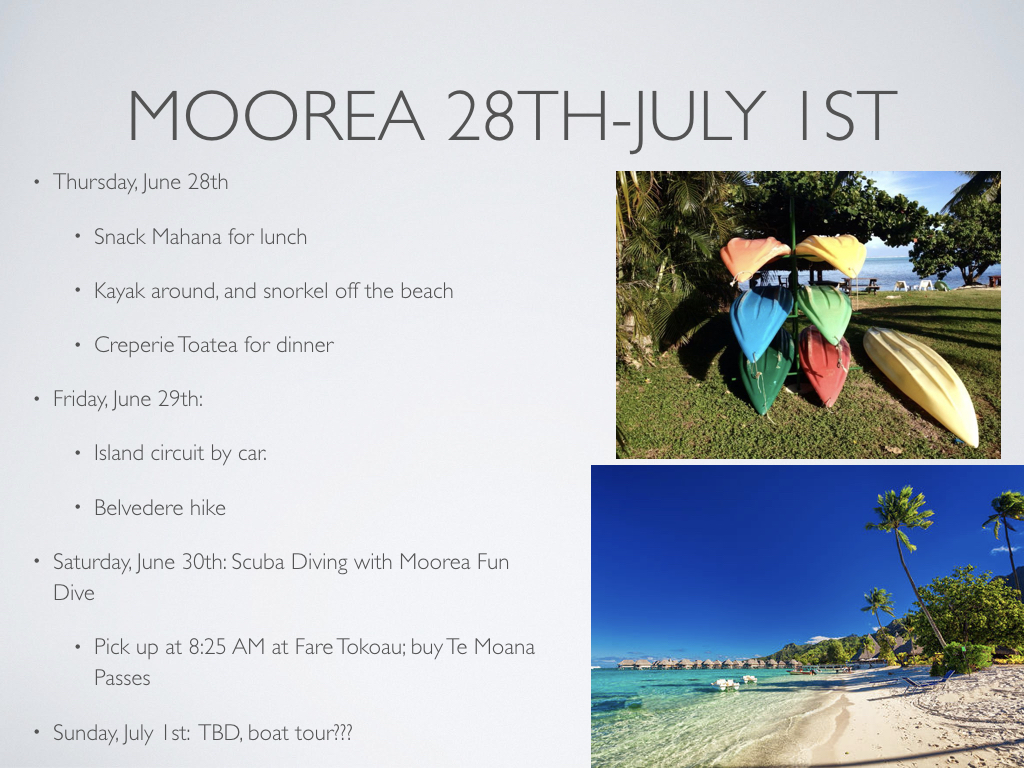
    French Polynesia Slide Show Presentation

    Here’s the slide show presentation that I made for planning our French Polynesia trip (we just recently got back). One of my coworkers’ husband made one for their South West USA trip, and I thought it was so remarkable that I had to copy it. 

    I did 100% of the planning for the trip, so it was a good tool to help my husband understand what to expect on our vacation. It was probably good that I did, because once the vacation started, he barely knew what Island we were on. (He literally thought we were on Bora Bora when we were actually on Moorea.) It also helped to convey to my husband what my expectations were, i.e. what I was really looking forward to trying. That being said, we didn't micro-manage the trip to every last detail - we were quite flexible in how we spent our vacation. There were a lot of empty time periods left in the schedule to improvise. We didn’t actually stick to the highlighted plan 100% either, and actually stuck to it maybe 30-40%. Actual details of what we did are forthcoming.

    I hope you enjoy the slides, and hopefully this can be helpful to others planning their French Polynesia trip.


    Sunday, April 01, 2018

    Leviathan Wakes - A Review

    "Leviathan Wakes"
    (This book review is part of my effort to write down a few words after every book I read.) 

    If you like science fiction, and love space opera in particular, then I highly recommend reading “Leviathan Wakes”. This is the first book in the 7-part “The Expanse” series by James S. A. Corey (a pseudonym for the writer duo, Daniel Abraham and Tyler Franck). And it is also the book upon which the first season of “The Expanse” TV show is based. I found the book just as riveting as the TV show and perhaps even more fast paced than the TV show. From what I understand, the show added sections from other books, such as what was happening on Earth, to show more facets of the space conflict, and to add more beef to the season.

    In the story, people have dispersed across the solar system. Human tensions are high between Earth, Mars, and the Belt - the poor communities that dot the asteroid belt. The book starts out with two parallel stories. Miller, a detective, is assigned to find Julie Mao, a rebellious rich girl from Earth who has disappeared. At the same time, a motley crew of ice haulers lead by James Holden, have been flagged down mid delivery to investigate a distress call in deep space. Pretty soon, both story lines merge in a satisfying way and war threatens to breaks loose throughout the solar system.

    Holden (R) and his partner are detectives hot on a case
    The Motley Crew of the Rocinante
    The book is a swashbuckling space opera in the best sense. There were plenty of epic space battles, and also plenty of exciting human shoot outs as well. There was a budding romance between Holden and Naomi, but more interestingly, a buddy romance between Holden and Miller as well. In one exciting sequence, both have been exposed to a deadly dose of radiation, but need to rely on each other to shoot through “vomit zombies” in order to reach their ship, where life-saving medications await. I also really appreciated the author’s visual imagination. There were some awe-inspiring space vistas, pulsing night clubs, all the way down to tightly cramped ships quarters reeking of unwashed bodies.

    One of the co-authors of the book, Ty Franck was formerly George R. R. Martin’s assistant. George R. R. Martin, in case you didn’t know, is the author behind the “A Song of Ice and Fire” books (the basis for “the Game of Thrones” TV series). The first few drafts of “Leviathan Wakes” were developed under Martin’s watchful eye. As a result, I see a lot of influences from George R. R. Martin’s “A Song of Ice and Fire” series on this book. Like in “A Song of Ice and Fire”, “Leviathan Wakes” has a complex plot line that really racks the reader’s brains to follow. There are feints and plot twists. The plot is revealed through characters’ points of view, who don’t always see the entire picture, so the reader is forced to put it all together themselves. I have seen the TV show, and I have read the first book, and I still struggle to fully grok the storyline and the different political interests. Another similarity with“A Song of Ice and Fire” series is that there are very strong, intelligent, fully fleshed female characters throughout. A final similarity is that the characters are not purely good or bad, especially in the case of Miller, the suicidal, broken cop who finds a hero’s purpose for the first time in his life in this novel. 

    This book has brought me a much greater appreciation for the TV series as well. The actors who play Naomi, Amos, and Miller characters are spot on. I must give the actor who plays Miller special praise. Thomas James is much younger and much handsomer than the character he is supposed to play, who is supposed to be near 50 and possessing a “sad, basset hound face”. Just watch him in HBO’s “Hung” to see how classically handsome he can be. But in the TV series, the actor has managed to distort his features and embody Miller’s greasy qualities.

    Finally, this book has some of the best space ship names ever.  The Rocinante, the Razorback, and Donnager are some of the quirkiest ship monikers I’ve ever heard. If ever I came to own a sail boat, I might have to name it The Rocinante for the way it rolls off the tongue.

    Sunday, March 25, 2018

    Rolfing Massage - Session 2: The Feet


    Correct foot alignment was the focus of my second Rolfing session
    I just received my Rolfing Session 2. (This blog post is a continuation from when I received my first session.)

    The timing of my massage session was horrible. I had gone from attending a stressful 4 hour phone conference, to racing off to work for a few hours. While at work, I became infuriated at one of my clueless coworkers who was working on my project behind my back. Before I knew it, it was time to leave work to drive to my massage appointment. During the 1 hour drive in horrible traffic, I tried to relax and calm down.

    Walking into Kelly’s office, I explained that I was stressed because of the traffic, and that I was angry at my coworker who I felt might be trying to undermine me. She immediately asked me where I stored my stress. I answered my legs and shoulders. Ignoring my answer, she immediately went to work on my stomach, explaining that there was a network of fascia radiating from the belly. I was surprised when she bore her elbow directly down on my belly button. I thought that feeling my my pulse underneath her elbow would freak me out, and thoughts of rupturing my abdominal aorta passed through my brain, but instead I felt extremely curious. It was unlike any sensation I had ever felt. I could not tell if I was feeling intestinal pain or if I was feeling fascial pain. It surprised me too when she let off the pressure, asking me whether or not I had felt the release. According to Kelly, the fascia in my belly had suddenly released. Unfortunately, I was too wrapped up in all the other strange sensations to register it.

    This rest of the session was focused on my feet and lower legs, which is traditionally what the Rolfing Session 2 is all about. As she explained to me, better alignment in my feet and legs results in better shock absorption when I’m walking, leading to less pain in my back. She said my ankles were tight and dedicated an hour plus on just my ankles, and the sides of my shins. She directed most of her effort on lengthening the inner side of my lower legs and feet, which seems counterintuitive at first since I thought I was rather flat footed. Per usual, I involuntarily yelped out in pain. But it began to make sense as the hour wore on what she was trying to do. Sitting at a chair is a good example. As you sit at a chair with knees at hip distance apart and feet parallel, do your arches reach the ground? Mine don’t. My feet tend to invert (see picture above) so that my outer soles touche, but my arches are raised. By lengthening my legs, my Rolfing massage therapist was trying to encourage a healthier walking stride and more supportive standing structure.

    It wasn’t until a day later that I felt the changes more fully. My legs were feeling all tender from the painful massage. My inner shin and inner ankles felt less tight. I paid attention more to my walk, focusing on preventing my foot inversion. But the biggest change of all was in my belly. I felt a lot of the tension there had disappeared. Oddly, I didn’t know there was even tension in my belly until it was gone. I guess Kelly was right. I must store stress in my stomach. I will forever remember to breathe down into my belly when I am stressed, and will even try poking at my belly to relieve tension. 

    (Epilogue: I gently confronted the coworker who had infuriated me the following day, and it turned out he wasn’t intentionally trying to undermine me at all. So all is well that ends well.)

    Sunday, March 11, 2018

    Rolfing Massage - Session 1

    So, I think I began my first Rolfing session. Last week, I met Rolfer, Kelly Armstadt for potentially the first session in the Rolfing 10-part series. This was the direct result of writing down some of my non-travel related bucket list items for the new year, which included experiencing Rolfing. (And I love me a list to cross off.)

    Just in case you don’t know, Rolfing is a special type of massage therapy which focusses on myofascial release for lasting pain relief, and for radically restructuring bodies. After undergoing the regimented 10-part series, people’s posture, and general biomechanics are purportedly more aligned and more efficient. Search the internet for “Rolfing” and you will see an abundance of before-and-after pictures. It is also known for: (1) humiliating photos in one’s underwear (see left picture), and (2) being very, very painful due to the deep restructuring. Kelly reassured me, however, that she had stopped taking photos of patients long ago, and that she would be attentive to when the pain wasn’t being beneficial. 
    Rolf Body Alignment Before-And-After
    Massaging the rib cage
    I undressed down to my bra and a pair of hot pants and stood in front of Kelly so that she could see how my body was aligned. As she viewed me from the front, side and behind, I felt surprisingly comfortable, albeit excited to explain to her why I was seeing her: I had some minor pain in my right lower back that nevertheless was limiting my mobility, and I had some concern about improving my body alignment so as to avoid hip problems as I got older. (My mother received hip replacement surgery for both hips.) I finally explained that I am just generally enthused and curious about learning about all forms of bodywork and experimenting on my own body. (I am also entertaining a career as a massage therapist or physical therapist in my retirement, although I didn’t tell Kelly that.)

    She explained that she saw some forward pelvic tilt, and some arching of my upper back to compensate, which wasn’t news to me and was what made me want to see a Rolfer in the first place. But she also saw some right shoulder drop, and some flat footedness, which wasn’t something that I had really thought could be addressed with Rolfing. 

    After laying down on her heated massage table, I was kind of half hoping that there would be some pain, because my belief is that there is no real improvement unless there is pain, and I wasn’t disappointed. She interspersed soothing strokes with strong pokes with her out-stretched fingers in so many weird places that I couldn’t help but involuntarily yell out in pain. Notably, she didn’t use any massage oil, I think, because fingers need to stick to the skin in order to shear and separate the myofascial tissues connecting skin to underlying muscle.

    This first session was about opening the breath. What this means is getting massaged around your sternum and rib cage, which wasn’t as ticklish or invasive as you might think. Nevertheless, it made me nauseous and I asked Kelly to stop so that I could sit up. Kelly told me that my nausea was probably due to being unaccustomed to being opened up in that way. After a few sips of water, I felt better and was ready to continue. Here were the things that were most interesting (read: painful) to me in my first session:
    1. Quadratus lumborum - this spot is better accessed from the side, and when she dug her thumb into this area, I yelped. As a part of my self care, I found a near analogue by lying on the ground and using the hooked end of my Therastick as a lever to poke around that area. You need extra leverage because this area is incredibly thick and stiff.
    2. That spot on my wrist between the ulnar and radius bones in my fore arm. My left wrist had been in pain, and I hadn’t even addressed that with her. But she found that spot on her own and bore down on it. Afterwards my wrist felt much better,
    3. The gluteus medius - this was so painful that it felt like she was bruising me rather than massaging me. But the pain is so worth it because you can feel your hip lengthen, and oddly you feel super sedated after being pushed down on this area.
    After the session was done, I noticed a dramatic change in the way that I was feeling. And that feeling translated to how I stood. My pelvis was not as forward tilted and my torso also felt longer. I felt like my lower back pain was noticeably improved as well. Unfortunately, a week has passed, and most of the stiffness and pain came back, probably due to sitting a lot at my job, and also due to some of the emotional patterns that I continue to manifest in my body. I have a feeling that undergoing the Rolfing 10 part series, may not be sufficient. However, I will still proceed with the Rolfing, just to satisfy my own curiosity, and to continue learning about my own body and methods for self-care.
      

    Saturday, February 24, 2018

    Peter And Wendy - A Review

    A mounted photograph from “The Castaway Boys of Black Lake Island”, one of the inspirations behind the tale of "Peter And Wendy"
    This review is part of my effort to write down a few words for every book that I read.

    “Peter And Wendy” is the children’s book by J. M. Barrie which, along with the play, inspired the classic Walt Disney animation, “Peter Pan”. I was motivated to read the book because Gretchen Rubin, the book author, and self-professed book lover recommended it. Also, I really enjoy historic children's literature. Disclosure, I have not yet seen the Disney film so I cannot provide much comparison with it.

    What I initially found fascinating about the book was it’s backstory. The author, J.M. Barrie was a successful playwright in England who eventually formed a tight-knit friendship with several young boys and their widowed mother, Sylvia Llewelyn Davies in the 1890s. The imaginative stories he invents for the boys to play-act later became the basis for “the boy who never grew up”.

    The friendship between J. M. Barrie and the Llewelyn Davies family was famously deep and unusual. The author, himself, was in a sexless marriage, and Sylvia, the mother, was young, attractive and widowed. However, their relationship never progressed beyond a close familial friendship. This was probably because Barrie was a gay man, although his sexuality was never identified conclusively. Nevertheless, their relationship was so close that Sylvia eventually granted Barrie guardianship of her children upon her early death from cancer.

    The family was deeply imaginative, and they enthusiastically took part in the playacting Barrie initiated. And the playing took on a vibrant intensity that I think was unusual. For example, The “Boy Castaways of Black Lake Island”, a novel that is enshrined at the rare books library at Yale, illustrates their adventures with mounted photographs and shows their deep investment to fantasy life. The deepness of their friendships, and their deep commitment to their fantasy life was eventually portrayed in the movie, “Neverland”, starring Johnny Depp and Kate Winslet.

    As for the book itself, I found it very well-written, laugh out loud funny, and not a little bit weird. The book is full of hallucinatory images that could have been the result of a drug-induced mind. I found it curious that the play preceded the book since many of its surreal scenes could not have been reproduced on a theater stage. For example, the Lost Boys enter and exit their underground home by shimmying up and down tree holes like worms. The father of Wendy imprisons himself inside their dog’s kennel. So serious is his commitment to inhabiting the kennel that he even goes to work and to fancy parties while inside the kennel.

    Lastly, I found the book’s attitude towards Never Land, and to fantasy, to be a little ambiguous. The whole assertion is that children’s imaginations are real, Never Land is real, and it is only because we stop believing as adults that we can no longer see Peter Pan, or go back to Never Land. However, while the children are in Never Land, they acknowledge that some of their play is NOT real. Sometimes they go to sleep hungry from the lack of real food, or when Peter Pan insists on eating pretend food. When the boys kill pirates, or when the Indians die, the deaths are taken lightly, as it would whenever children play. Peter Pan is the only character who is fully committed to their shared reality.

    20 Goals for 2019

    I know the year is already half over, but here are my goals for 2019 (this was not finished earlier as my goals kept changing).  Soci...